

It’s terrifying, but it now seems totally possible that by the late 2030s, in the height of summer, the North Pole could be open ocean with no ice.
That image alone feels like the stuff of apocalyptic sci-fi. But as my guest Steven Lezak argues, if we frame climate only as “the end of the world,” we risk doing something dangerous: paralyzing people - or convincing them we were exaggerating all along.
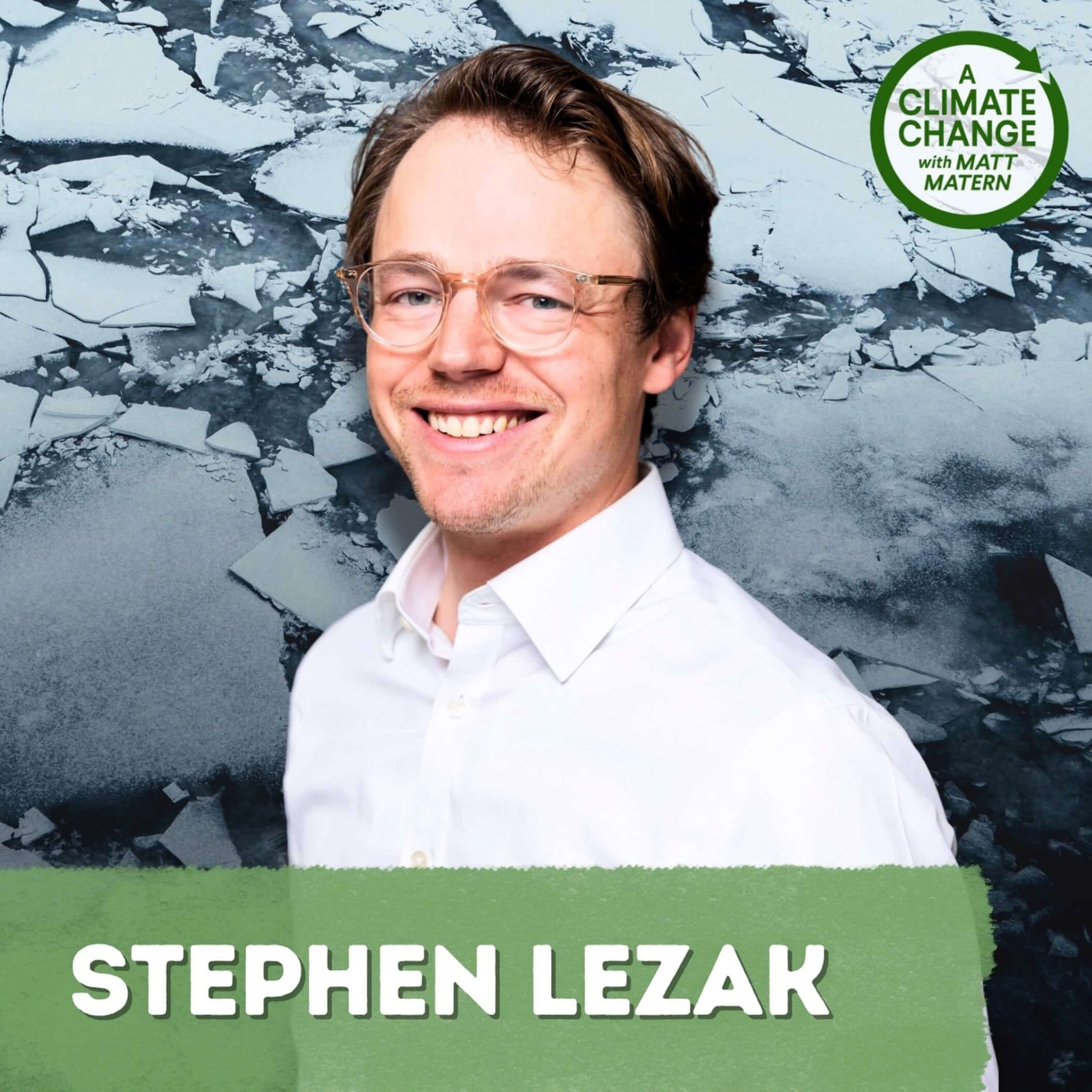
In this episode of A Climate Change, I spoke with Steven, a polar and climate justice researcher with a PhD from Cambridge, an expert reviewer on the IPCC Sixth Assessment Report, and a research fellow at UC Berkeley’s Goldman School of Public Policy. He’s currently writing a book on climate justice in the Arctic, The Longest Night: Coming Home in the Age of Apocalypse (working title), due out in 2026 from Simon & Schuster.
Our conversation ranged from Bill Gates’s latest climate memo and nuclear-war metaphors to rights of nature, carbon offsets, China’s clean-energy strategy, and what an ice-free Arctic summer will really mean for humans and non-humans alike.
From “Rocks for Jocks” to Climate Justice in the Arctic
Steven didn’t start out as a climate guy. He started out looking for an easy science elective.
In college, a friend suggested a class called “Geology 120: Rocks for Jocks,” the kind of course you take to round out a brutal semester. Instead, it cracked his worldview open.
A couple of lectures on deep time - geologic timescales measured in centuries and millennia - forced a question most politics never touch:
What does social justice look like if you’re not thinking in terms of election cycles, but in terms of centuries - or even thousands of years?
That question pulled him from short-term political fights toward something deeper: How do we become responsible stewards of a planet that’s changing very quickly?
After Oberlin, he did a stint as a ski bum near Lake Tahoe, then applied to grad school on a whim, more to escape the grind of job rejections than to fulfill some grand plan. When Oxford said yes, he packed a bag and went.
From there, his work turned toward indigenous environmental governance - first in Mongolia, and eventually in Alaska, where he’s spent the past six years working closely with Inupiaq and Yupik communities. Those relationships now shape the way he thinks about climate, justice and the future.
Who Is the Future For? Western “Ownership” vs. Indigenous “Kinship”
One of Steven’s core questions is deceptively simple:
When we say we’re trying to secure a safe environmental future… who are we securing it for?
In the dominant Western tradition - which Steven, as a white American of European descent, situates himself inside - nature is often framed as a garden made for us. Think of the Garden of Eden: God creates the garden, then creates humans and says, in effect, “This is for you. Don’t wreck it.”
Even in its greener forms, this story still centers human flourishing. The environment is a resource, or at best a backdrop, for our success.
But in many indigenous and non-Western worldviews, Steven notes, there’s a very different starting point: kinship instead of ownership. Glaciers, rivers, mountains, animals—they’re not just “resources” for human use; they are beings with their own standing and value.
That shift isn’t just philosophical. It leads to radically different policy ideas—like the emerging movement for rights of nature:
New Zealand granting legal personhood to a river and a national park.
Latin American countries incorporating rights of nature into their constitutions.
A tribe in the Upper Midwest granting rights to wild rice, a sacred traditional food.
These laws are still new, and courts haven’t fully tested them. But Steven thinks they could be transformative. Just as changing the legal drinking age reshaped cultural norms around alcohol, recognizing legal rights for rivers or mountains could shift how people ethically perceive things like mountaintop removal or river pollution.
Laws don’t just reflect culture, he reminds us. They create culture.
Bill Gates, Existential Threats, and the Politics of Doom
A big part of our conversation centered on Bill Gates’s recent essay arguing that climate, while serious, may not be the biggest threat facing humanity - and that global philanthropy might be better focused on other suffering, like poverty and disease.
Some critics say Gates is “kissing the ring” of Trump and anti-climate forces. Steven isn’t so sure. Gates is one of the richest people in the world, actively accelerating the drawdown of his foundation’s funds. He doesn’t obviously need to curry favor with anyone.
Steven sees something else: a backlash against a certain style of climate messaging that frames global warming as the singular, all-defining, existential threat—the “end of the world” narrative.
And that brings him to a quote he brought to our conversation from writer Dorian Lynskey, describing Cold War nuclear rhetoric:
“If you tell people that the cost of failure is world destruction, and then fail, then they are left with either the psychologically insupportable prospect of constant dread or the impression that you were exaggerating the stakes. Neither response inspires action.”
That line wasn’t written about climate. It was written about nuclear war. But the parallel is obvious.
Steven’s view, stated carefully and with some reluctance, is this:
Climate change will almost certainly not cause the literal extinction of humanity.
It will cause an “insane” amount of suffering for hundreds of millions - possibly billions - of people this century.
For some communities and nations, it will be “the end of their world,” even if it’s not the end of the species.
So the moral core of climate politics, as he sees it, should be less about speculative human extinction and more about responsibility and justice:
We in the rich, high-emitting parts of the world are causing vast, avoidable harm in places like Pakistan, Bangladesh, Haiti and Western Alaska—and it would be the height of irresponsibility to abandon people to problems we created.
Frontline Communities: Why Climate Is Never “Just” About Climate
One of the humbling things Steven points out is that in many frontline communities, people aren’t actually talking about “climate change” the way policy wonks do.
They’re talking about:
Whether they can afford to rebuild after a storm.
Whether the next hurricane will level their neighborhood because building codes are weak and materials are poor.
Whether they can move to safer ground at all.
Compare Florida and Haiti. Both get hammered by hurricanes. But in Florida, people generally have stronger homes, better insurance, more robust institutions. In Haiti—the poorest country in the Western Hemisphere - a big storm can erase entire neighborhoods, over and over.
The “determining factor,” Steven says, is rarely just the weather. It’s resources, political stability, and safety nets.
In Alaska, where he works, climate change is happening faster than almost anywhere on Earth. Communities that already lost so much through colonization and forced assimilation are now watching their coastlines crumble, sea ice vanish, and traditional hunting practices become dangerous or impossible.
Seeing climate through their eyes, he says, is “such a valuable perspective for thinking about the present and the future.” It reframes the conversation from abstract degrees Celsius to whose worlds are ending, and why.
An Ice-Free Arctic Summer and Uncharted Waters
So what happens if the North Pole really does become open ocean by the late 2030s?
First, a quick primer Steven offered:
The North Pole is ocean covered by sea ice.
The South Pole (Antarctica) is a continent covered by a mile-thick ice sheet in places.
An ice-free Arctic summer wouldn’t by itself cause massive sea-level rise - that’s more about Greenland and Antarctica. But it would be catastrophic in other ways:
Polar bears and walrus, who live more on ice than land, would lose their primary habitat.
Indigenous communities that hunt on the sea ice would see their entire way of life destabilized.
The loss of bright, reflective ice accelerates polar amplification - the process where the Arctic warms far faster than the global average because darker ocean absorbs more heat.
And then there’s the uncertainty problem.
We’re running one massive, uncontrolled experiment on the only planet we have. The best scientists in the world are trying to model what happens on supercomputers, but:
We’ve never increased CO₂ this high, this fast, in Earth’s history.
There’s no way to run a lab experiment where we “dial CO₂ up to 500 ppm and see what happens.”
The error bars on our simulations are large - especially for tipping points like ice-sheet collapse in Antarctica.
As Steven puts it, “We’re playing with fire in a big way,” in a society that rewards short-term profits over long-term stability.
Carbon Offsets, Cap-and-Trade, and the Grift We Don’t Have Time For
Closer to home, Steven has also been digging into California’s cap-and-trade program and the murky world of carbon offsets.
In theory, offsets sound simple:
You emit a ton of CO₂ but pay someone else not to emit a ton somewhere else - say, by not cutting down a forest - and the climate is supposedly no worse off.
In practice? The best research suggests that most offsets don’t do what they claim. Steven points to analysis indicating that California’s official forest offsets program likely overstates climate benefits by around 400% on average.
In other words, we’re spending hundreds of millions of dollars on projects that largely would have happened anyway - often in places like Arkansas - while telling ourselves we’re tackling the crisis.
Why would California allow this?
Because offsets are politically convenient. They let fossil fuel companies say:
“Don’t worry, we can keep extracting. We’ll just offset, offset, offset.”
Steven and his colleagues at Berkeley proposed a different model:
If companies are going to spend money on offsets, fine - but let the state direct that same money into genuinely effective conservation and climate projects, instead of funneling it through a grifty, consultant-driven offset market.
They didn’t get everything they wanted, but there was progress: California changed the rules so that offsets are now “below the cap” rather than above it. That means every offset used cancels out a regular allowance, instead of expanding total allowed pollution. It doesn’t fix the junk offset problem, but it does prevent offsets from secretly increasing emissions.
In today’s climate politics, Steven says, “we take our wins where we can get them.”
China, the U.S., and Who Wins the Clean Energy Race
We also dug into a question that keeps popping up:
If China is dominating solar, wind, and battery manufacturing while the U.S. pours money into AI, are we betting on the wrong future?
China has spent years quietly locking down global supply chains for “critical minerals” - often through overseas mines with serious human-rights concerns - then processing those materials at home into wind turbines, solar panels, and EV batteries.
Last year, China reportedly installed more renewable capacity than the rest of the world combined.
This isn’t because China has hordes of visible climate activists marching in the streets. It’s because its leadership sees clean energy as cheap, secure, and strategically smart. In Steven’s words, it’s a “technocratic, authoritarian government” that’s less constrained by fossil-fuel ideology than the U.S., where a whole political faction is emotionally and culturally tied to drilling and petrochemicals.
Meanwhile, some countries with no oil—like Ethiopia and others looking hard at their balance of trade - are beginning to say, in effect:
“Why keep importing expensive fossil fuels when we can harvest free sun and wind?”
Norway is another example Steven loves to cite: a petro-state whose sovereign wealth comes from fossil fuels - and yet 90% of new cars sold there are EVs. In the U.S., we’re still at about 10%.
His takeaway:
The clean energy transition is ultimately inevitable, but that doesn’t mean it will be fast enough. Political headwinds, entrenched interests, and false cheapness of fossil fuels (once you ignore health costs like asthma and premature death) can slow it dangerously.
Making Environmentalism Exciting Again
One hopeful thread running through our conversation is the idea that climate politics doesn’t have to be a slog of sacrifice and doom. It can be creative, radical, and even joyful:
Granting legal rights to rivers, mountains, glaciers.
Designing laws that don’t just “manage decline” but really re-imagine our relationship with the non-human world.
Crafting narratives that hold onto the urgency of climate risk without defaulting to “world destruction” rhetoric that pushes people into dread or denial.
As Steven put it near the end of our conversation, we need to “make environmentalism exciting again.” Not by minimising the danger - we talked at length about how scary an ice-free Arctic is - but by widening the story: from extinction panic to justice, responsibility, belonging, and possibility.
Where to Find Steven and Support This Work
Unlike most guests, Steven isn’t on social media. By choice.
You can find him:
By email, if you want to reach out about his work
His forthcoming book, The Longest Night: Coming Home in the Age of Apocalypse, will explore these themes of Arctic climate justice, rights of nature, and what it means to come home to a world in rapid change.
If You Want to Go Deeper
If this conversation resonated with you, here are a few ways to keep it going:
Listen to the full episode with Steven Lezak on A Climate Change for the complete discussion on rights of nature, carbon offsets, China vs. the U.S., and more.
Help us plant 30,000 trees in the Amazon. Learn more about our reforestation work and how to support it at our website (and get a free tree!)
Subscribe & share. You can find A Climate Change on Apple, Spotify, YouTube, or wherever you get your podcasts. If this episode gave you a new angle on climate risk and justice, please share it with a friend.
We may not be able to stop the Arctic from warming overnight. But we can change the stories we tell, the laws we pass, and the responsibilities we’re willing to shoulder - for each other, for the more-than-human world, and for the generations who will inherit the future we’re creating now.
This is a really thorough interview, thanks for sharing! I like the perspective of doing as much as you can to mitigate climate change while keeping a realistic view (rather than apocalyptic) to keep people going.
Last note: HUGE fan of Rocks for Jocks intro classes! That’s exactly how I got into Earth Science, and continues to inspire my podcast today.
Hey I think you will like this. Just go through this once. Welcome to The Positive News Network.
PNN is a satirical series following Blake Sterling, a news anchor who spins every catastrophe into feel-good content. Each episode explores how media, corporations, and governments profit from disasters while maintaining professional optimism.
This is a work of fiction and satire. The disasters are real. The spin is exaggerated. The commentary is intentional.
Enjoy.
https://open.substack.com/pub/thebiologicalimagination/p/the-positive-news-network-episode?r=6ubx0q&utm_campaign=post&utm_medium=web&showWelcomeOnShare=false