

These questions once lived at the fringes of environmental law. Today, they are appearing in courtrooms, national constitutions, and international legal debates around the world.
In this recent episode of A Climate Change, we spoke with journalist Katie Surma, one of the leading reporters covering the global rights of nature movement. What she describes is nothing short of a transformation in how the law—and society—thinks about the natural world.
And the momentum is accelerating.

From Property to Rights Holder
Modern legal systems generally treat nature as property.
Forests can be owned. Rivers can be diverted. Oceans can be mined or fished—so long as regulations are followed. Environmental law largely focuses on managing how much damage humans are allowed to cause.
The rights of nature movement challenges that foundation.
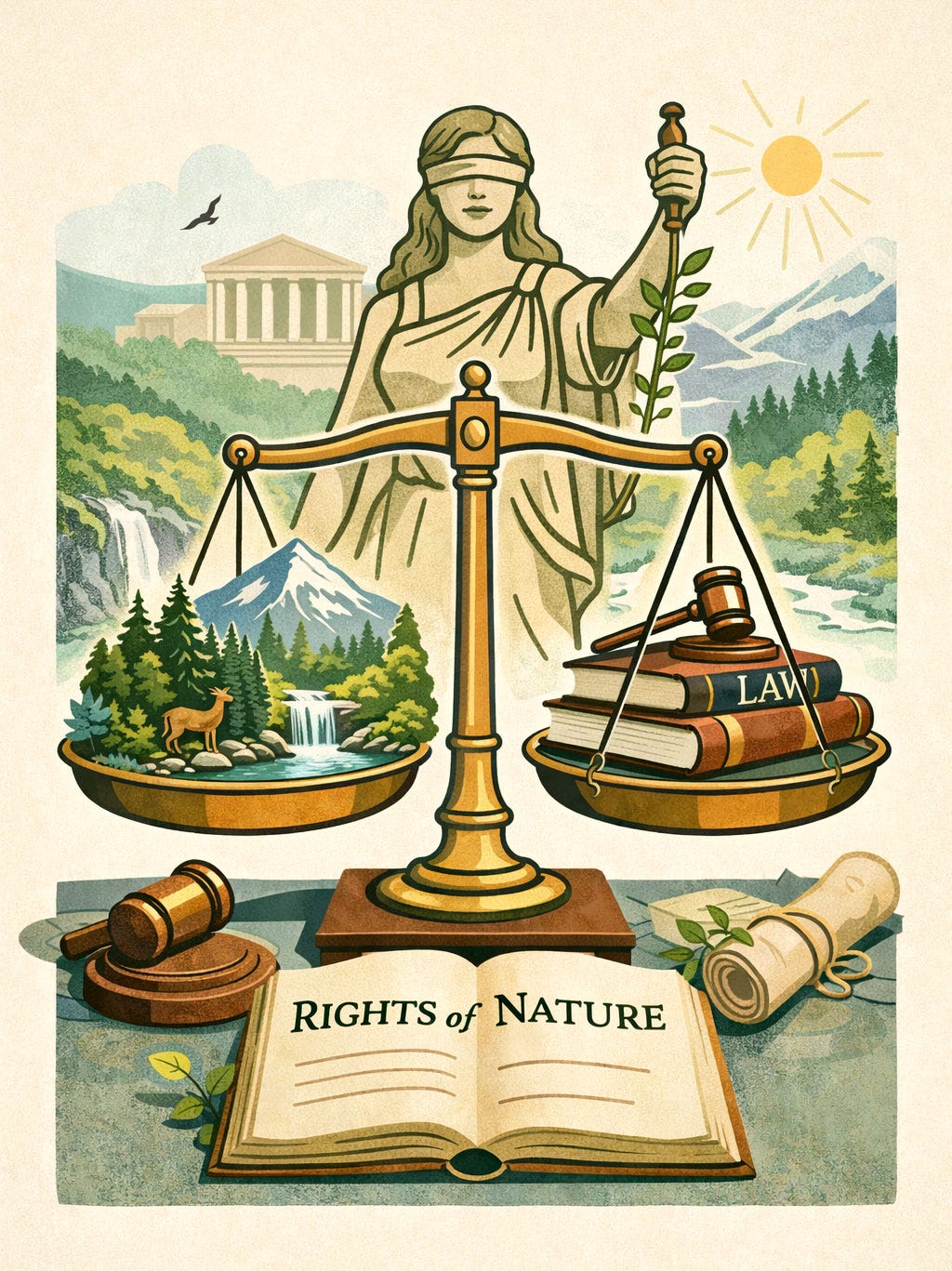
Instead of treating ecosystems as objects to be regulated, it proposes something radical: nature itself should possess legal rights.
That means ecosystems could have rights such as:
The right to exist
The right to regenerate
The right to maintain ecological integrity
The right to evolve naturally
Under this framework, environmental destruction would not simply be a regulatory violation. It could be treated as a violation of rights.
It sounds revolutionary. Yet similar legal constructs already exist.
Corporations—entities that exist only on paper—possess legal rights. Ships have legal standing. Governments themselves are legal persons.
The question emerging worldwide is straightforward:
If corporations can have rights, why not ecosystems that sustain life on Earth?
A Whale’s Right to Migrate
One of the most fascinating developments comes from the Pacific.
Indigenous leaders from New Zealand and other Pacific communities recently developed a groundbreaking treaty proposing that whales should be recognized as rights-bearing beings.
The proposal would protect fundamental rights such as:
The right to migrate
The right to a healthy ocean environment
The right to cultural and ecological continuity
If implemented into New Zealand law, it could become one of the most ambitious legal recognitions of animal rights ever attempted.
The effort combines Indigenous legal traditions, cutting-edge science, and environmental law.
Researchers working with the Cetacean Translation Initiative are even using artificial intelligence to analyze sperm whale communication—an attempt to better understand the complexity of whale societies.
The science is revealing remarkable parallels between whales and humans:
Sperm whales live in multi-generational family groups
Grandmothers play a role in cultural transmission
Younger whales learn behaviors from elders
Their communication systems may contain structured language elements
When you start to see whales not as resources but as complex societies, the legal question begins to look different.

The Real-World Threats
These legal innovations are not theoretical. They emerge from urgent environmental realities.
For example: Ship strikes kill an estimated 20,000 whales each year.
Modern cargo ships are larger and faster than anything whales evolved alongside. Many whales cannot detect the ships until it is too late.
But solutions exist.
Studies show that simply slowing ships to 10 knots in key migration corridors dramatically reduces whale deaths. It also cuts pollution from shipping—equivalent to removing hundreds of thousands of cars from the road.
In other words: protecting nature often produces win-win outcomes.
Where the Movement Is Growing Fastest
The rights of nature movement has exploded globally over the past decade.
Major developments include:
Ecuador
In 2008, Ecuador became the first country to place rights of nature directly into its constitution.
Courts there have since issued rulings protecting ecosystems, sometimes requiring projects to be redesigned or relocated to prevent environmental harm.
Panama
Panama passed national laws recognizing the rights of nature and specific protections for sea turtles.
Spain
Spain granted legal rights to Mar Menor, a large coastal lagoon suffering severe pollution.
Indigenous Nations
Many Indigenous communities worldwide—including tribes in the United States—have adopted rights of nature frameworks rooted in traditional ecological knowledge.
What is striking is that these changes are not limited to one ideology or region.
They are appearing in South America, Europe, Oceania, and parts of the United States.
Why the United States Has Struggled
Despite its environmental movement, the United States has had difficulty adopting rights of nature laws.
Local communities—from Pennsylvania to Washington State—have attempted to pass them through ballot initiatives. Many were later struck down due to state preemption laws, which prevent local governments from regulating certain issues.
Advocates increasingly believe the key step will be state-level legislation or state constitutional amendments.
If a state constitution explicitly recognized the rights of ecosystems, it would be far harder for courts to overturn.
A Legal Idea Borrowed from Employment Law
One intriguing possibility comes from a concept familiar to many lawyers: private attorney general enforcement.
In employment law, individuals sometimes sue not only for themselves but also to enforce public rights on behalf of the state.
A similar framework could apply to nature.
Instead of relying solely on government regulators like the EPA, any person could bring a lawsuit on behalf of an ecosystem if its rights were violated.
This model already exists in Ecuador, where citizens have legal standing to defend nature.
The implications would be profound. Environmental protection would no longer depend entirely on political administrations or regulatory agencies.
The Cultural Shift
Beyond legal mechanics, the rights of nature movement represents something deeper.
It is a shift in worldview.
Instead of seeing humans as separate from nature, the movement frames humanity as part of an interconnected ecological system.
Scientists increasingly support this perspective.
Ecosystems do not function as isolated components. A river cannot be separated from the forests that feed it, the fish that inhabit it, or the climate that sustains it.
Environmental damage in one area often cascades through entire systems.
Recognizing rights for nature, many scientists argue, aligns the law more closely with ecological reality.
The Human Stakes
The movement is also deeply connected to environmental justice.
Research shows that in the United States, communities of color lose access to green space at roughly three times the rate of white communities.
Polluting industries are disproportionately located near poorer communities. Environmental degradation often follows the same patterns as economic inequality.
Around the world, the stakes can be even higher.
Environmental defenders—especially Indigenous activists—are frequently threatened or even killed for protecting ecosystems from extractive industries.
For many of these communities, recognizing nature as a legal subject provides moral legitimacy and legal tools for resistance.
What Comes Next
The rights of nature movement is still young, but it is spreading rapidly.
Advocates see several potential paths forward:
State constitutional amendments
International treaties protecting ecosystems
Legal guardianship systems for rivers, forests, or species
Broader recognition of environmental human rights
Perhaps most importantly, the movement is reshaping how people think.
When people begin to see rivers, forests, and animals not as objects but as participants in the legal and moral community, the conversation about environmental protection fundamentally changes.
A New Legal Frontier
Environmental law has traditionally asked:
How much damage are humans allowed to cause?
The rights of nature movement asks a different question:
What does nature need to thrive?
That shift may ultimately prove transformative—not only for the law, but for our relationship with the planet itself.
And as the movement grows—from Ecuador’s courts to New Zealand’s whales—it is becoming harder to dismiss the possibility that one day, ecosystems around the world may indeed have their day in court.
Listen to the Full Conversation
If you’re interested in the legal, scientific, and political frontiers of climate and environmental law, you can listen our my full conversation with Katie Surma of Inside Climate News.
🎧 Subscribe to A Climate Change wherever you listen to podcasts so you never miss an episode.
You can find the show on: Apple Podcasts, Spotify, YouTube, or your favorite podcast platform.

A fascinating read. The idea of granting legal rights to nature challenges the way many of us have traditionally viewed the environment.
This debate goes beyond environmental protection.
Not a new concept. See Should Trees Have Standing, by Christopher Stone, published 1972