

“The fossil fuel industry convinced us the climate crisis is a suicide, not a homicide.”
That framing is not just clever. It’s paralyzing.
If people believe the crisis is primarily their fault—too many flights, too much plastic, the wrong car—then the logical response is self-correction. Recycle more. Consume differently. Try harder.
But there’s a problem: individual guilt does not scale into systemic change.
And in politics, scale is everything.

The Inconvenient Truth About Climate Politics
As the 2026 midterms approach, the climate movement faces a structural reality it has long avoided:
It does not have enough political power.
Not because people don’t care—but because they don’t act on that concern where it matters most: the ballot box.
Nathaniel Stinnett, founder of the Environmental Voter Project, frames the issue bluntly:
There are tens of millions of Americans who care deeply about climate change
Many of them do not vote regularly—or at all
Meanwhile, smaller, highly motivated groups vote in every election, no exceptions
That asymmetry defines political outcomes.
A Movement Built on the Wrong Theory of Change
For decades, climate advocacy has leaned heavily on persuasion:
Educate the public
Raise awareness
Shift consumer behavior
But Stinnett’s data suggests something counterintuitive:
The climate movement doesn’t primarily have a persuasion problem. It has a turnout problem.
In other words, the issue is not that people don’t believe in climate change.
It’s that they don’t translate that belief into political participation.
The Recycling Trap
One of the most revealing findings comes from polling.
When asked how to address major political issues like gun violence or immigration, people overwhelmingly propose policy solutions:
Pass laws
Change regulations
Enforce rules
But when asked about climate change?
The dominant answer is:
Recycling.
This is not a trivial detail—it’s diagnostic.
It shows that people do not instinctively view climate change as a political problem requiring political solutions.
Instead, they frame it as a matter of personal responsibility.
That framing is not accidental.
How the Narrative Was Engineered
The fossil fuel industry has invested heavily in shaping public perception.
The result is a reframing of the crisis:
From systemic failure → individual responsibility
From policy solutions → lifestyle adjustments
This shift has two effects:
It diffuses accountability
It suppresses political urgency
If the problem is “me,” then the solution is incremental self-improvement—not collective action.
And that leads to paralysis.
Why Individual Action Isn’t Enough
Even extreme personal sacrifice has limits.
One MIT study found that even if the average American lived like an “itinerant monk”—giving up nearly all consumption—their carbon footprint would still exceed the global average due to structural factors:
Energy grid composition
Transportation infrastructure
Urban planning
Industrial systems
These are not consumer choices.
They are policy outcomes.
The Real Lever: Voting Behavior
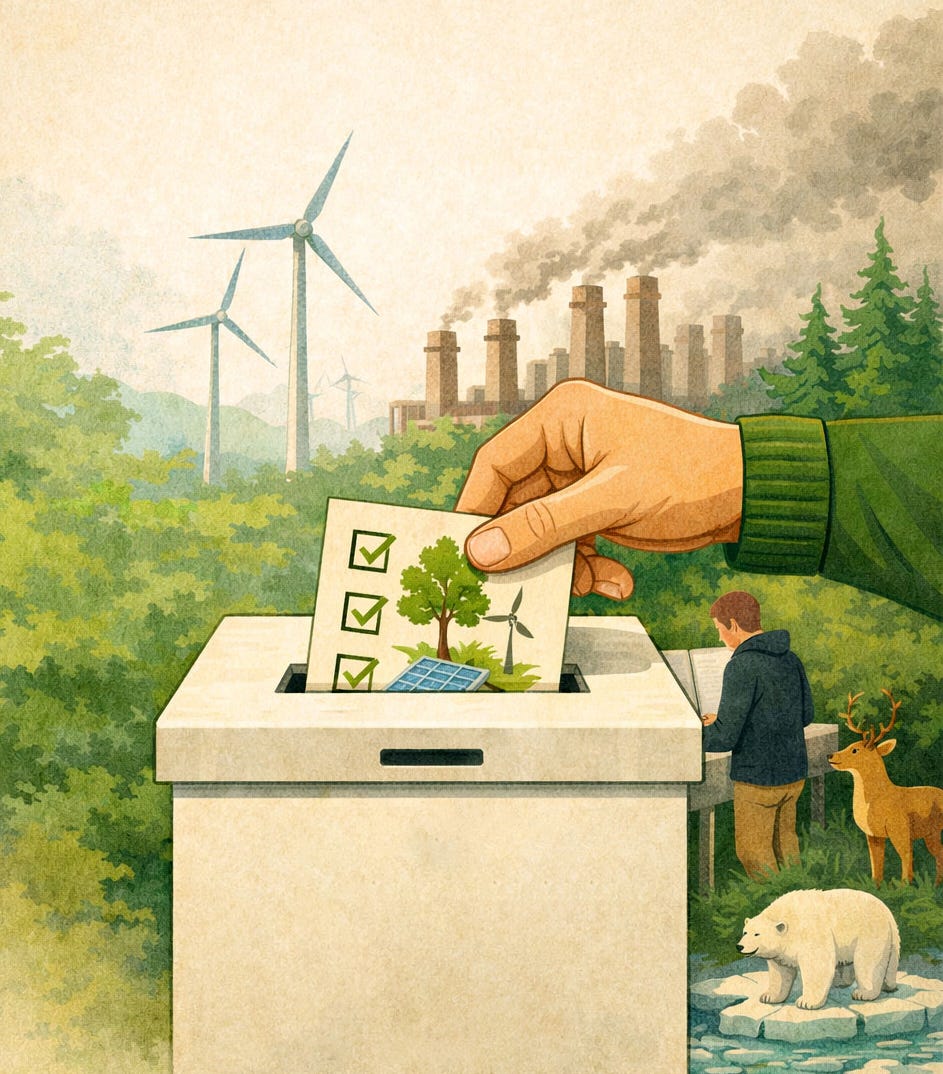
The Environmental Voter Project focuses on a narrow but high-leverage intervention:
Identify people who already prioritize climate—and get them to vote consistently.
This is not persuasion. It is behavior modification.
Their model:
Use large-scale polling and data modeling to identify “climate-first” individuals
Target low-propensity voters (people unlikely to vote regularly)
Apply behavioral science techniques to increase turnout
The premise is simple:
If even a fraction of these voters become habitual voters, political incentives shift.
Behavioral Science > Political Messaging
The tactics are intentionally non-ideological and often surprisingly simple.
1. Social Pressure
People are more likely to vote if they believe others around them are voting.
Example:
“107 people on your block voted last election.”
This has nothing to do with climate messaging—but it increases turnout.
2. Commitment Framing
Instead of asking whether someone will vote, ask how they will vote:
By mail
Early
On Election Day
This reframes voting as an assumed action, not a decision.
3. “Endowed Progress”
Borrowed from behavioral economics.
If people feel they’ve already made progress toward a goal, they are more likely to complete it.
Messaging example:
“You’re registered” ✅
“You’re on the voter rolls” ✅
“Next step: vote” ⬜
This creates psychological momentum.

The Scale of Untapped Power
The numbers are material:
3.4 million identified environmental voters being targeted in 2026
Many have never voted in a midterm election
Concentrated in key states like Texas and North Carolina
Even small turnout increases matter.
In controlled trials, the program has increased turnout by ~1–2 percentage points.
In electoral terms, that margin can determine outcomes.
Why Climate Still Loses Politically
Despite broad concern, climate consistently underperforms as a voting issue.
Why?
Because intensity matters more than volume.
Political systems reward reliable participants, not passive agreement.
The Communication Gap
There is also a messaging failure.
Climate communication often relies on:
Data
Models
Scientific abstraction
But behavior change is driven less by rational analysis and more by identity and social cues.
As Stinnett puts it:
“Humans are much more social than rational.”
Historically effective movements—from the American Revolution onward—used:
Simple language
Emotional framing
Identity-based appeals
The climate movement has largely not.
What Actually Moves People
The most effective messages do not try to educate.
They answer a different question:
“What kind of person am I?”
Examples:
A good citizen
A responsible neighbor
Someone who follows through
Voting becomes a way to affirm identity—not solve a policy problem.
Where This Leaves Us
The climate movement faces a strategic fork:
Option 1: Continue persuading
More education
More awareness
More individual action
Option 2: Build political power
Identify existing supporters
Convert them into consistent voters
Shift incentives for policymakers
The second path is less visible—but likely more decisive.
Final Point: This Is Still Early
One of the more striking admissions in the conversation:
The climate movement is not yet politically powerful enough to compel action.
That is not a messaging failure alone.
It is a participation gap.
And participation can change faster than beliefs.
If You Care About Climate, This Is the Question
Not:
Do you believe climate change is important?
But:
Do you vote like it is?
Subscribe for More
If you want analysis at the intersection of climate, law, and political power:
Subscribe to A Climate Change
Follow for breakdowns of environmental strategy and policy
Share this with someone who cares—but doesn’t vote
Because the next phase of climate action is not awareness.
It’s turnout.
To listen to the full episode, go to Apple, Spotify, or YouTube.
A really good article
It’s sad that the people who need to see this can’t read