
Grandma Shouldn’t Be Paying for Data Centers
Why the energy transition will fail without affordability, fairness, and a little common sense.

“Grandma doesn’t need to be paying for Elon Musk’s data centers.”
That line stopped me.
Not because it was flashy. Because it was precise.
In a single sentence, Michelle Moore — CEO of Groundswell and author of Rural Renaissance — cut through the fog that so often surrounds debates about energy, climate, and infrastructure. The issue is not abstract. It is not theoretical. It is not about impressing think tanks or winning jargon contests. It is about who pays, who profits, and whether ordinary people are expected to absorb the cost of an energy system being rapidly reshaped around AI, data centers, and surging electricity demand. Groundswell says its work is aimed at affordability, resilience, and cutting household electricity bills through community solar, resilience hubs, and home energy efficiency.
And right now, that question is landing at the kitchen table.
Electricity bills are rising across the country. Families already squeezed by housing costs and groceries are being told, implicitly or explicitly, that more pain is coming. Meanwhile, many of the biggest new electricity demands are not coming from households. They are coming from hyperscale data centers and large industrial loads racing to power the AI buildout.
Moore’s point is straightforward: if the grid is changing to serve a new class of massive energy consumers, then households should not automatically be handed the tab.
That is not anti-growth. It is not anti-technology. It is just basic fairness.

The real energy crisis is happening at home
One of the most useful things about this conversation was Moore’s insistence on describing the current moment accurately. We are not only dealing with a climate challenge or an infrastructure challenge. We are in an affordability crisis.
That matters because it changes the terms of the debate.
When energy policy is discussed in Washington, it often gets framed as a battle between fuels, ideologies, or emissions targets. But in living rooms and kitchens across the country, people are asking a simpler question: Can I still afford to keep the lights on?
That is where energy politics becomes real.
And this is where Moore is especially persuasive. She does not treat solar, efficiency, and resilience as abstract environmental goods. She treats them as practical tools that can lower bills, stabilize communities, and help people weather both storms and economic pressure. Groundswell says it is on track to deliver more than $29 million in annual energy savings to 36,000 households and deploy more than 40 resilience hub projects across 12 states by 2030.
That framing is exactly right.
If clean energy is going to win politically, it cannot be sold only as a moral imperative. It also has to win on price, speed, reliability, and common sense.
Solar is no longer the side argument
For years, clean energy was often pitched as the virtuous alternative — better for the planet, but politically vulnerable whenever critics raised cost or reliability concerns.
That era is ending.
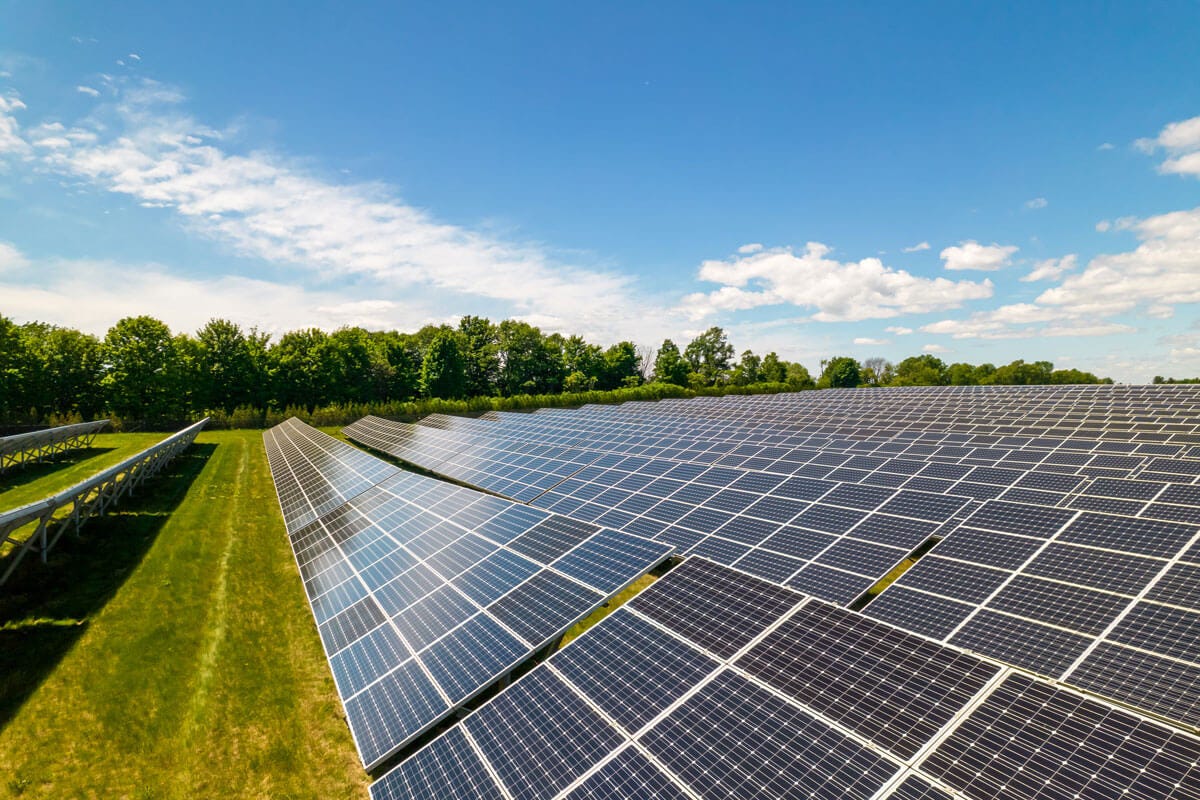
Moore makes the case that smaller, distribution-scale solar projects have become especially valuable in this moment because they can be deployed more quickly, locally, and affordably than many legacy alternatives. Groundswell’s public materials similarly emphasize community solar as a way to expand affordability and resilience locally.
That speed matters.
If gas turbine supply chains are years out, and if demand is rising now, then the country needs solutions that can actually come online in time to matter. Local solar, community storage, and efficiency upgrades may not satisfy everyone’s ideological preferences, but they do satisfy a more urgent requirement: they can help now.
And in politics, “can help now” usually beats “might help later.”
The least sexy solution may be the most important
There was another point in this conversation that deserves far more attention: energy efficiency.
It rarely gets treated as headline material. There is nothing glamorous about insulation, roof repair, air sealing, or updated HVAC systems. But Moore makes a compelling case that efficiency is one of the most underrated tools in the energy toolbox — and one of the least understood.
She also points to something many policy conversations ignore: in a large share of homes, especially in rural and lower-income communities, efficiency work cannot begin with a shiny rebate form and a contractor quote. It begins with a leaking roof, mold, rot, broken electrical systems, and long-deferred repairs. Groundswell’s “Soul Save” and related efficiency work explicitly combine energy upgrades with enabling home repairs, and its Westside Resilience Corridor program includes home energy efficiency and repair support.
That is a crucial insight.
America’s energy burden is tied to America’s housing burden. If a home is physically falling apart, energy savings are harder and more expensive to achieve. In that sense, efficiency policy is also housing policy. Any serious effort to lower bills at scale has to deal with both.
That is what makes Moore’s approach feel more grounded than a lot of national rhetoric. She is not describing a theory. She is describing what happens when you get behind the walls.
Data centers can be good neighbors — or not
This was the sharpest part of the discussion.
Across the rural South and beyond, data centers are moving in. They bring investment, construction, tax negotiations, political pressure, and a massive appetite for power. Moore’s position is not reflexively hostile. She acknowledges that large corporate actors can be constructive partners. Groundswell’s Westside work, for example, has involved partnerships around efficiency, workforce preparation, and resilience-oriented local investment. Groundswell also states publicly that the Corridor includes workforce development and resilience hub expansion.
But the larger warning is unmistakable: not every company is using that playbook.
That is the policy fight of the next decade.
If large energy users want access to communities, land, water, grid capacity, and public incentives, then local residents should be asking hard questions up front:
Who benefits?
Who pays?
Who gets lower bills?
Who gets reliability?
Who gets left with the long-term burden?
Rural communities, in particular, have too often been treated as extraction zones — places where land, labor, and infrastructure are used cheaply while the upside flows elsewhere. Moore’s argument is that this cycle should stop.
That is not a niche concern. It is central to whether the AI economy ends up deepening inequality or helping address it.

The federal government is stepping back from affordability
Another major theme in the interview was the retreat of federal support.
Moore describes Groundswell as having received major federal awards that were later terminated, even as the organization continued advancing projects through utility, local government, and corporate partnerships. Groundswell’s official site says it is continuing to build community power and expand resilience despite the changing policy landscape.
Her broader claim is that federal policy is moving away from “kitchen table” affordability and toward subsidizing large corporate and industrial priorities.
Whether one agrees with every part of that diagnosis or not, it captures an important shift in mood. More Americans are starting to sense that the public case for energy investment is one thing, while the distribution of benefits is something else entirely.
If public money supports the system, but ordinary households still see rising bills, then trust erodes fast.
And once trust erodes, even good projects become harder to build.
A better slogan than “electrify everything”
The environmental movement has often struggled because it defaults to technical language when what people need is moral clarity and material benefit.
Moore’s language is better.
She talks about “doing well by doing good.” She talks about the kitchen table. She talks about loving your neighbor. She talks about practical solutions that lower bills, strengthen communities, and make local infrastructure more resilient.
That language works because it ties energy policy to daily life.
It also makes room for coalition politics. You do not have to agree on every ideological premise to agree that electricity should be affordable, abundant, and cleaner over time. You do not have to share the same politics to agree that new demand should pay its fair share. And you do not have to adopt every climate slogan to recognize that local solar, storage, and efficiency can make communities stronger.
That may be what Moore means by “principled unity.”
Not unanimity. Not sameness. Not purity.
Shared goals, pursued through practical means.

What people should demand now
If there is one policy takeaway from this conversation, it is this: residential consumers need breathing room.
Freeze residential rates while the system catches up.
That does not solve every problem. But it does acknowledge a basic inequity in the present moment. Households did not create the AI electricity boom. They should not automatically be the ones financing its first wave of infrastructure.
At the same time, Moore argues for accelerating whatever local efficiency and solar incentives still exist, before they disappear or shrink further. That advice is practical and immediate. Use the tools that exist now. Deploy projects that can save money now. Build local power before the window closes.
There is no grand mystery here. The basic formula is visible:
Lower waste.
Build local.
Protect households.
Demand fair deals from powerful newcomers.
Keep the focus on affordability.
The line that should stick
A lot of podcast interviews generate soundbites. Few produce a sentence that feels like it should become a public campaign.
This one did.
“Grandma doesn’t need to be paying for Elon Musk’s data centers.”
Strip away the name, and the argument still lands: ordinary people should not be forced to subsidize a new energy economy that promises enormous private upside elsewhere.
That is the message regulators, public service commissions, utilities, lawmakers, and local officials need to hear clearly.
Because if the clean energy transition becomes one more story in which powerful institutions socialize the costs and privatize the gains, public support will fracture.
But if the transition lowers bills, increases resilience, speeds deployment, and produces fairer deals for local communities, it can build a much broader coalition.
That is not just good policy.
It is common sense.
Follow Groundswell’s work: Groundswell is a nonprofit focused on community power, affordability, resilience, community solar, and efficiency. Michelle Moore is its CEO and the author of Rural Renaissance.
Follow A Climate Change with Matt Matern: At the heart of our podcast lies a profound commitment: to inform, inspire, and initiate action. Through each engaging episode, we peel back the layers of climate change, presenting complex issues in a manner that’s effortlessly comprehensible. Learn more at our website.
Episode links: Apple, Spotify, iHeart, and YouTube.

The Great Awakening begins, a profound shift in knowledge is happening and history will be rewritten with the findings under the the Sphinx & the Great Pyramid!!! Soon The Hall of Records will be revealed!!! BTW ANGLES NOR DEMONS NEED FLYING SAUCERS!!! 👽👽👽🥱
https://youtu.be/zYVdeQDPsus?si=3XjWOd0pORIhvFmh
….nor should anyone else.