

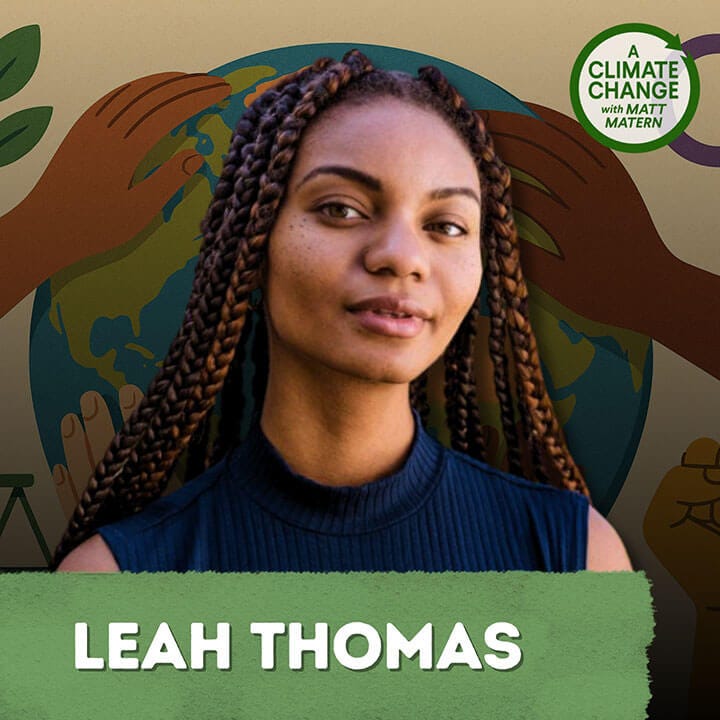
For years, the environmental movement has talked about inclusion - about making sure Indigenous communities and marginalized people have a seat at the table. But as climate activist and author Leah Thomas explains, that conversation is no longer enough.
“Now we’re at the next phase,” Leah says. “Not only do we need a seat at the table, we need to make sure people actually have a voice and decision-making power.”
That shift - from representation to real authority - was at the heart of our wide-ranging conversation on A Climate Change, where Leah joined me to discuss intersectional environmentalism, joy as resistance, crafting as climate action, and why despair can’t be the end of the story.
From Catching Toads to Climate Justice
Leah’s environmental journey didn’t begin with policy papers or protest marches. It started in the Midwest, just outside St. Louis, running around outdoors - catching toads, digging holes, and enjoying nature without ever calling it “environmentalism.”
“I didn’t really know that word,” she says. “I just knew being outside was something I enjoyed.”
It wasn’t until college - while studying environmental science during the rise of the Black Lives Matter movement - that Leah began connecting environmental issues with racial and social justice. Clean air, clean water, and safe living environments, she realized, weren’t evenly distributed.
That insight became the foundation of her work: caring about the planet by way of caring about people.
Learning What’s Possible at Patagonia
After college, Leah landed at Patagonia - working as an assistant to legendary climber Rick Ridgeway and Patagonia’s director of philosophy, Vincent Stanley. It was there that she saw a radically different vision of what a company could be.
On-site childcare. Massages and chiropractic care. Employees skipping work to protest for the planet. A company built on values, not just profits.
“I saw what was possible,” Leah says. “And that’s what gave me the courage to leave.”
That leap eventually led her to found Intersectional Environmentalist, a platform and nonprofit that reframes environmental education by asking a critical question often left out of the conversation:
Not just what is happening - but who is being impacted.
Since 2020, the organization has created more than 1,000 educational resources, helping people understand how environmental harm intersects with race, class, labor, and health.
Why Shame Doesn’t Save the Planet
One of the most refreshing parts of Leah’s work is her rejection of guilt-driven environmentalism.
For too long, she argues, sustainability has been framed as restriction, punishment, or moral superiority - electric cars you can’t afford, perfect glass containers you don’t own, and a constant sense that you’re “doing it wrong.”
“I don’t want people to think the environmental movement is about shame,” she says. “Or that you have to sacrifice happiness to be sustainable.”
Instead, Leah uses creativity, humor, and accessibility - talking about thrifted fashion, crafting, cats, and even wildflowers baked into old clothing - to invite people in rather than push them away.
Sustainability, she insists, can be joyful.
Crafting, Creativity, and Climate Hope
That philosophy extends into Leah’s love of crafting - sewing, mending, making gifts, and building skills that reduce waste while increasing connection.
“Crafting is a great pathway into environmentalism,” she says. “It makes life more fun.”
Whether it’s learning to sew, making plant-based milk at home, or bartering skills with friends, Leah sees everyday creativity as a form of quiet resistance - a way to reclaim agency in systems designed around overconsumption.
Individual Action and Systems Change
One of the most powerful moments in the conversation came when we talked about the false divide between individual action and systemic change.
People often dismiss small actions as meaningless. But history tells a different story.
“Rosa Parks refusing to get up looked like an individual action,” I noted. “And it sparked a movement.”
Leah agrees. Individual action doesn’t exist in a vacuum - it creates ripples, models new possibilities, and builds community. The problem isn’t choosing one over the other; it’s pretending they’re mutually exclusive.
Environmental Human Rights
When asked what a truly intersectional climate agenda looks like, Leah returned to a simple but radical idea: environmental human rights.
Clean air.
Clean water.
Safe, healthy living environments.
Access to nutritious food.
These shouldn’t be privileges - or zip-code-dependent outcomes - but enforceable rights.
Yet decades-old data shows that a majority of Black Americans live in counties that violate federal air quality standards. The issue isn’t lack of knowledge - it’s lack of enforcement and political will.
“An intersectional environmental movement,” Leah says, “would make sure these rights are equally enforced - regardless of race, income, or where you live.”
Start Local. Start Now.
For anyone feeling overwhelmed - or unsure where to begin - Leah offers simple advice:
Start local.
Look up an environmental justice organization in your city. Learn its name. Follow it. Sign up for its emails. Visit a community garden. Learn the environmental history of your neighborhood.
“Knowing what’s happening where you live makes you feel empowered,” she says. “That’s where change becomes real.”
Joy as a Form of Resistance
As we wrapped up, Leah shared what might be her most important message of all: be kind to yourself.
In a world of constant crisis headlines, burnout is real - and despair is exactly what broken systems thrive on.
“Joy has to be part of our activism,” she says. “When we’re kinder to ourselves, we’re kinder to our communities - and then to the planet.”
Her ancestors danced through hardship. She crafts through climate anxiety. And she reminds us that sustainability isn’t just about saving the future - it’s about how we choose to live now.
🎧 Listen to the full episode wherever you get your podcasts
📘 The Intersectional Environmentalist by Leah Thomas
🎙️ Check out Leah’s podcast As She Rises
🌱 Learn more about our work and help us plant 30,000 trees in the Amazon at aclimatechange.com
If this piece resonated with you, please share it and keep the conversation growing.